.png)

Blog
.jpg)
Porque é que o Conteúdo Genérico de IA é Ignorado?
Sente que o seu feed nas redes sociais está sempre a repetir-se? Percorre o Facebook ou o Instagram e tem aquela sensação clara de déjà vu. Vê um anúncio, depois outro, e outro — e, embora sejam de setores completamente diferentes, todos partilham exatamente a mesma estética.
O padrão é inconfundível: tipografia exagerada e uma composição rígida que revela tudo o que precisa de saber sobre como foi feito. Nem precisa de perguntar; sabe simplesmente que veio diretamente de uma ferramenta de IA.
Trocámos o "o meu sobrinho desenha isso de graça" pelo "o ChatGPT fez o folheto em dois minutos". Mas o problema não é propriamente a qualidade do design — é a uniformidade criativa. Quando todos têm acesso às mesmas ferramentas, o perigo é que as marcas comecem a parecer, a sentir-se e a soar de forma idêntica, perdendo, em última análise, a sua identidade única no processo.
O dilema da IA não é a tecnologia em si
A adoção da IA tornou-se um pilar das operações criativas diárias. Um relatório recente da Alison.ai, uma plataforma especializada em inteligência criativa e otimização de anúncios, lança luz sobre a mudança profunda que está a ocorrer em todo o setor.
Com base no inquérito de tendências de 2026 da Smartly — que auscultou 450 líderes de marketing — as conclusões são reveladoras: 75% dos inquiridos manifestaram preocupação com o facto de o conteúdo gerado por IA estar a conduzir à homogeneização das marcas, tornando as empresas cada vez mais indistinguíveis entre si. Ainda mais impressionante é o facto de 86% dos líderes de marketing admitirem ter encontrado ativos criados por IA que poderiam facilmente ser confundidos com os de um concorrente direto.
A integração destas ferramentas é quase universal, com 95% das equipas criativas a incorporarem agora a IA generativa nos seus fluxos de trabalho padrão.
E isso faz todo o sentido. Quando milhares de pessoas dependem das mesmas ferramentas, prompts e referências visuais, o resultado começa inevitavelmente a convergir.
.png)
A IA não é uma solução mágica
Para muitas empresas, a IA parece a solução definitiva: é rápida, acessível e produz conteúdos em segundos, prometendo resultados imediatos com o mínimo de tempo e orçamento. No entanto, pela nossa experiência na Positive, simplesmente escrever um prompt não é suficiente.
Para muitas empresas, a IA parece a solução definitiva: é rápida, acessível e produz conteúdos em segundos, prometendo resultados imediatos com o mínimo de tempo e orçamento. No entanto, pela nossa experiência na Positive, simplesmente escrever um prompt não é suficiente. No nosso dia a dia, recorremos à IA para gerar imagens, produzir conteúdos de vídeo e criar propostas comerciais. Mas aprendemos da forma mais difícil que obter um resultado de qualidade exige uma pesquisa profunda, iterações intermináveis, o ajuste fino de instruções, o teste de diferentes plataformas e o consumo de mais tokens do que gostaríamos de admitir. O primeiro rascunho raramente é a versão final. E é exatamente aqui que entra o único elemento que nenhuma ferramenta consegue replicar: o discernimento criativo humano.
.png)
A Criatividade Ainda Precisa de uma Bússola Humana
Embora seja evidente que a IA acelera os fluxos de trabalho, o discernimento humano continua a ser insubstituível. Pode ter acesso a ferramentas que produzem ideias, rascunhos ou elementos visuais em segundos, mas estas carecem de uma compreensão fundamental do seu público e daquilo que realmente define a sua marca. É por isso que não deve colocar o seu processo criativo em piloto automático. O que faz com que o resultado gerado por IA se destaque não é o software que escolhe, mas sim as decisões criativas e deliberadas que toma para o orientar. Em suma, o objetivo não é temer a tecnologia, mas evitar entregar-lhe as rédeas. A IA pode certamente acompanhá-lo no percurso, mas a direção criativa e estratégica deve permanecer firmemente nas mãos de quem melhor conhece a sua marca.
É por isso que não deve colocar o seu processo criativo em piloto automático. O que faz com que o resultado gerado por IA se destaque não é o software que escolhe, mas sim as decisões criativas e deliberadas que toma para o orientar.
Em suma, o objetivo não é temer a tecnologia, mas evitar entregar-lhe as rédeas. A IA pode certamente acompanhá-lo no percurso, mas a direção criativa e estratégica deve permanecer firmemente nas mãos de quem melhor conhece a sua marca.
.jpg)
Porque é que o WhatsApp está a impulsionar o comércio na América Latina?
Quantas vezes já consultou o WhatsApp hoje? Se vive na América Latina, a resposta é, provavelmente, mais vezes do que consegue contar. Para milhões de pessoas em toda a região, esta aplicação é o centro onde a vida quotidiana acontece. Usamo-la para falar com amigos, marcar reuniões, agendar consultas médicas e, cada vez mais, para fazer compras. Na América Latina, o WhatsApp é mais do que uma simples ferramenta de mensagens; está entranhado no próprio tecido do nosso dia a dia.
Embora isto nos pareça o padrão, a realidade é diferente noutros locais. Na região, uma única aplicação domina o panorama das comunicações, mas em mercados como os Estados Unidos, os utilizadores dependem de uma mistura fragmentada de canais — desde SMS e iMessage a FaceTime — para se manterem ligados.
Os dados confirmam esta divisão. Segundo números da Aurora Inbox, que citam a Statista e o DataReportal, a penetração de mercado do WhatsApp ultrapassa os 90% em vários países-chave da América Latina: Brasil (99%), Colômbia (94%), México (93%), Chile (92%), Argentina (90%) e Peru (89%). Em contrapartida, o Pew Research Center refere que apenas 32% dos adultos nos Estados Unidos utilizam a aplicação, onde o SMS e o iMessage continuam a ser os canais preferenciais para a comunicação digital.
Do comércio eletrónico ao comércio conversacional
O percurso de compra nem sempre começa num motor de busca ou termina no checkout de um site. Na maioria das vezes, começa com uma simples pergunta num chat.
Antes de avançarem com a compra, os consumidores querem confirmar detalhes, pedir recomendações, comparar opções ou simplesmente verificar se existe uma pessoa real por detrás da marca. Essa troca de mensagens minimiza a incerteza e cria um sentido de ligação que uma experiência digital totalmente automatizada muitas vezes não consegue captar.
É precisamente por isso que o WhatsApp Business se tornou uma ferramenta tão vital para as empresas na América Latina. A plataforma permite que as empresas criem perfis comerciais, apresentem catálogos, automatizem respostas e geriam interações com clientes — transformando, efetivamente, um canal que antes era estritamente pessoal num espaço onde as vendas e as relações profissionais podem prosperar.
.png)
O WhatsApp como o braço direito do comércio eletrónico
Isto não significa que o comércio eletrónico tradicional tenha perdido a sua relevância. Os websites continuam a ser fundamentais para a descoberta de produtos, pesquisa detalhada e finalização de transações. No entanto, em muitos casos, o WhatsApp funciona como a ponte que guia o consumidor através do processo final de tomada de decisão: esclarece dúvidas pendentes, elimina fricções e ajuda a converter uma simples intenção numa venda bem-sucedida.
Não é por acaso que o WhatsApp desenvolveu uma versão dedicada às empresas. Com funcionalidades como perfis comerciais, catálogos de produtos, respostas automáticas e soluções de nível empresarial, o WhatsApp Business é a prova de como a plataforma evoluiu para satisfazer uma procura existente: os consumidores querem falar com as marcas antes de se comprometerem.
Para as empresas que pretendem crescer na América Latina, compreender como os consumidores comunicam é tão importante como saber o que compram. Nesta região, a conversa é uma parte fundamental da jornada de compra — uma jornada que, muitas vezes, começa e termina dentro de uma conversa no WhatsApp.
.png)
Peru Is Key: From Meme to Global Digital Powerhouse
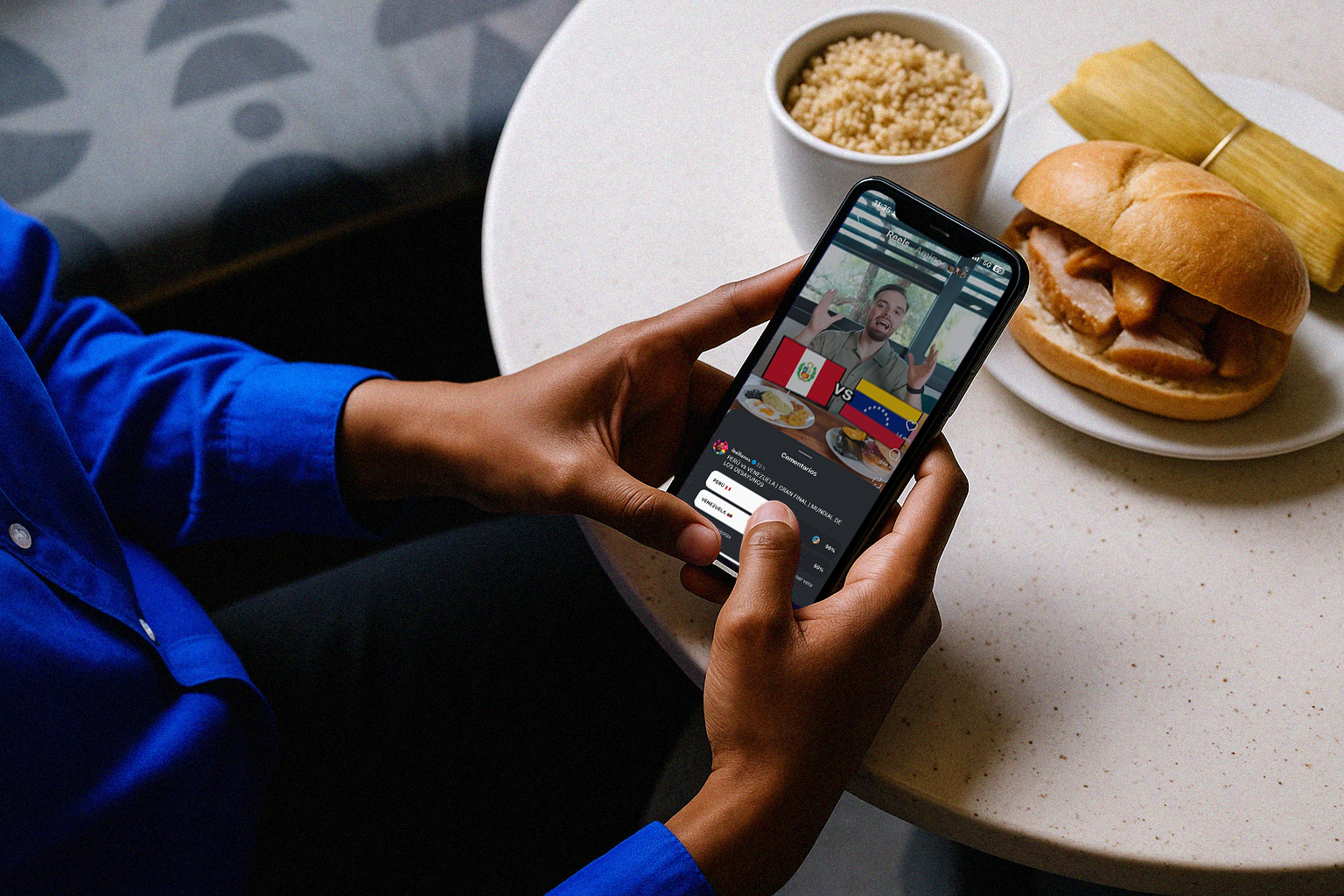
Peru is key! You see it in every post, every viral meme, and every achievement making noise around the world—from gastronomy to video games. What started as a TikTok joke has become a shout of national pride, and the visit of U.S. streamer IShowSpeed to Lima proved it: he not only hung out with local influencers, he was even named “mayor for two hours” and pulled off an acrobatic jump from the municipal balcony that went viral. From that moment on, media outlets and online communities echoed the phrase with force:
saying “Peru is key” is no longer just a meme—it’s the way to shout “Long live Perú!” to the world.
It’s not a trend, it’s love for chicharrón.
Have you voted for the pan con chicharrón yet? Hurry up, the final is almost here!
It’s the shout echoing everywhere: on social media, in the news, and even in the streets—no matter the brand or industry.
Peru ’s digital boom has been fueled by viral moments like the “Peru is key” meme, IShowSpeed’s visit, and above all, Ibai Llanos’ Breakfast World Cup. In this online tournament, Perú crushed it with over 8.1 million votes for its pan con chicharrón and tamal, beating Ecuador and going global. The hype was so big that politicians, media, and local brands jumped in, while Gamarra—the country’s biggest clothing hub—even launched custom T-shirts about the contest. This event didn’t just spark citizen excitement, it also cemented Peruvian gastronomy as a true nation-brand icon online, showing its massive pulling power and international reach.
Because Peru doesn’t just have the world’s best restaurant... it probably has the best too!
Once you’re on the bus, there’s no getting off.
Your child settles onto your lap, you light the fireplace, your eyes grow misty, and you begin to tell the story. If Peru once was key to the world, now it’s key to the entire digital universe. The gamer boom also carries a Peruvian face: in August 2025, the team Perú Unite made history by becoming champions of the Pokémon UNITE World Championships in California—making them the first Latin American team to ever lift the world trophy after defeating the Japanese favorites, Zeta Division, 3-1. “I mean, we beat the creators of the game.
The achievement of these five young Peruvians was celebrated as a source of national pride and recognized by international outlets like Infobae and Yahoo News, which highlighted how they “conquered the World Championship... securing the franchise’s most important trophy for the South American nation.
The phrase “Peru is key” went viral once again, as the tournament brought together more than 25,000 live attendees in Anaheim and reached nearly 1.1 million unique online viewers, with peaks of 185,000 simultaneous streams, cementing Peru’s presence before the eyes of the world.
The team itself thanked the support from home, reinforcing the idea that Peruvian talent transcends borders and that Spanish-speaking audiences deeply value their local champions. And beyond the sport, this victory ignited marketing as well: brands tied to gaming—hardware, telecommunications, energy drinks, and more—found in Peru a passionate and growing niche. Combined with other milestones like gaming tournaments, massive streams, and viral phenomena, this triumph positions Peru firmly on the global digital map, proving that its online culture is not just fleeting virality, but the consolidation of communities—gamers, foodies, streamer fans—driven by a uniquely Latin American passion.
The Peruvian Formula: Creativity, Community, and Digital Speed
What makes Peru’s digital ecosystem unique isn’t just virality, but the combination of three forces: creativity, community, and speed. Peruvian creativity shows up in memes, trends, and narratives that stand out in an ocean of global content. Community amplifies those ideas with overwhelming energy—from young people spontaneously launching digital campaigns to local brands cleverly joining the conversation. And then there’s speed: within hours, a meme born on TikTok can trend on X, Facebook, and even reach traditional media. This trio explains why phenomena like “Peru is key”, the Breakfast World Cup, or the Pokémon UNITE championship win are not isolated events but symptoms of a larger pattern: Perú has become a cultural accelerator for the region. For global brands, this means that any action in this market doesn’t just make waves locally—it has the potential to scale across all of Latin America.
“Dad, who was Peru Unite?”
Your child settles onto your lap, you light the fireplace, your eyes grow misty, and you begin to tell the story. If Peru once was key to the world, now it’s key to the entire digital universe. The gamer boom also carries a Peruvian face: in August 2025, the team Perú Unite made history by becoming champions of the Pokémon UNITE World Championships in California—making them the first Latin American team to ever lift the world trophy after defeating the Japanese favorites, Zeta Division, 3-1. “I mean, we beat the creators of the game.
The achievement of these five young Peruvians was celebrated as a source of national pride and recognized by international outlets like Infobae and Yahoo News, which highlighted how they “conquered the World Championship... securing the franchise’s most important trophy for the South American nation.
The phrase “Peru is key” went viral once again, as the tournament brought together more than 25,000 live attendees in Anaheim and reached nearly 1.1 million unique online viewers, with peaks of 185,000 simultaneous streams, cementing Peru’s presence before the eyes of the world.
The team itself thanked the support from home, reinforcing the idea that Peruvian talent transcends borders and that Spanish-speaking audiences deeply value their local champions. And beyond the sport, this victory ignited marketing as well: brands tied to gaming—hardware, telecommunications, energy drinks, and more—found in Peru a passionate and growing niche. Combined with other milestones like gaming tournaments, massive streams, and viral phenomena, this triumph positions Perú firmly on the global digital map, proving that its online culture is not just fleeting virality, but the consolidation of communities—gamers, foodies, streamer fans—driven by a uniquely Latin American passion.
Why is investing in Latin America key for global brands?
Latin America is no longer just an “emerging market.” Today, it’s a cultural and digital laboratory setting global trends. This entire movement has direct consequences for marketing: it shows that Latin America —and Peru in particular— has become a strategic and vibrant market for any global brand seeking relevance, where trends born from memes, gaming tournaments, or viral phenomena quickly spread and spark national pride.
The achievement of these five young Peruvians was celebrated as a source of national pride and recognized by international outlets like Infobae and Yahoo News, which highlighted how they “conquered the World Championship... securing the franchise’s most important trophy for the South American nation.
Joining these movements in real time (as KFC, Bembos, or BCP did with #PeruEsClave and the World Breakfast Cup) allows brands to connect emotionally with young, digital first consumers, who already surpass 70% internet penetration and 90% mobile access in the region.
Moreover, campaigns that reinforce local identities (such as pan con chicharrón or Peru Unite) enhance brand-country perception and open opportunities in booming sectors such as e-commerce, fintech, gaming, and entertainment. Sponsorship of events and collaborations with influencers or creators multiply organic reach in an ecosystem where culture —gastronomy, music, sports, memes— acts as an exportable form of soft power, and where authentic engagement can outperform million-dollar campaigns.
In conclusion, Latin America is now a global cultural laboratory, with Peru as its best example, showing that digital not only amplifies narratives but also strengthens passionate communities, turning the region into an unmissable destination for brand innovation and growth.
Positive leads the way in the new digital map.
At Positive, we understand that it’s not enough to simply “be on social media”—you need to understand the culture that drives it. Perú and Latin America are fertile ground for brands looking to grow, but they require strategy to avoid going unnoticed. That’s why we identify local insights that become global—such as gastronomic pride or gaming passion—and translate them into campaigns with regional impact and international resonance. Our approach blends creativity with data, combining qualitative analysis of trends, communities, and narratives with quantitative tracking of mentions, engagement, and hashtag growth to design strategies that are both measurable and effective.We know how to authentically place brands within viral phenomena, as many did by joining #PeruEsClave. We act as a bridge between the local and the global, helping brands from the U.S. or Europe connect with Latin American audiences through trust and real engagement. And we do it with close, memorable communication—crafting narratives that move people, spark laughter, invite participation, and turn consumers into fans. In short: Positive helps you ride the digital cultural wave of Latin America so your brand is not just a witness to what’s happening, but a protagonist in the conversations that matter.
.png)
UGC, CGC, IGC or What You See?
It All Started as Gossip and Turned into a Trend.
In Latin America, we always say gossip isn’t really our thing... but come on! We can’t help but smile when someone starts with the classic, “Did you hear?” or when a friend leans in quietly to say: “I’ve got chismecito.”
The same thing happens in the digital world. One day, you find yourself debating, laughing, and sharing memes about someone who appeared in a viral video... someone you probably barely know.
And that’s how this whole mess began: a video posted by content creator @_suplinna set off a snowball of comments about “doing UGC in Latin America.”
What is UGC?
UGC stands for User Generated Content: content created by regular, everyday users—not paid or pressured by brands—born from a genuine experience.
Think of it this way: when a customer uploads a photo or writes a comment without any payment involved, that’s authentic UGC.
According to Wikipedia, this type of content has allowed consumers to move from being passive participants to becoming active contributors on digital platforms.
And here’s a key stat: 79% of millennials and 70% of Gen Z make purchasing decisions basedon UGC.
Furthermore, “user-generated content influences the purchases of 79% of consumers, and 92% trust peer recommendations more than branded content.”
This proves that without a clear understanding of UGC, we risk losing the authentic touch that truly drives people to act.
What’s the State of UGC in Latam?
While in the U.S. and Europe many brands already include it as a key part of their business strategy, in Latin America the idea still lingers that a proper UGC execution is simply “I’ll send you one of my products so you can post something,” overlooking one of the most important promotional vehicles for generating awareness on digital channels.
Whether due to a lack of knowledge from the brands themselves or a lack of guidance from their agencies, the creative process for developing a UGC campaign often lacks clear KPIs, variety in entry hooks, proper editing by the agency, optimization of formats for media placement, or even the basic understanding that a UGC creator should know if their content will be boosted or not, and for how long.
As @mila_posada points out in this video:
In Latin America, only 37.7% trust sponsored posts, a figure that aligns closely with Europe andthe U.S., where the average is around 35%–39%, according to this data from Single Rain.
In contrast, well-executed UGC —the kind that feels like it came from an everyday person— has far greater power to connect than an influencer with all the production resources at their disposal.
On the other hand, according to a global report, the UGC marketing market is expected to grow from USD 6.7 billionin 2024 to USD 132.7 billion in 2034, with a CAGR of 34.8%.
This is a clear sign that our region is still not in sync with what’s coming.
The Confusion: Everything’s Called UGC
Here’s the big problem: many people call anything “UGC” if it’s a video with good editing, nice lighting, and camera flair, when in reality it’s paid branded content or disguised influencer work. It’s not that these productions are bad or less effective, but they lead to some serious misunderstandings:
- Brands don’t know if they’re paying for authenticity or for production.
- Creators don’t know how to position themselves: does authenticity have less value than a well-scripted, well-edited video?
- The audience grows distrustful: if everything looks paid, who’s really saying, “this is dope”?
This video of @yuyo.says can actually help us understand the communication differences between one and the other.
Clear Differences to Avoid Confusion
These acronyms are everywhere, but it’s important to keep them straight:
- UGC (User Generated Content): spontaneous, authentic content created by regular users.
- IGC (Influencer Generated Content): content from people with an audience, who usually charge for it —this production is no longer anonymous.
- CGC (Creator Generated Content or Company Generated Content): content created either by the brand or by hired creators, with an editorial focus and controlled quality.
According to Territory Influence: "UGC thrives on authenticity and community, while IGCl everages the influence and creativity of people with an established online presence."
So, how should these differences be addressed in a campaign led by a marketing agency? This video by @theinexpert explains it:
Where Should We Go Next?
These acronyms are everywhere, but it’s important to keep them straight:
- Market Education: Brands and agencies must know how to distinguish between UGC, IGC, and CGC, and use each one in its proper role.
- Creator Professionalization: Creators should know how to quote, deliver, and sell their proposals without disguising themselves as UGC when they are actually IGC or CGC.
- Building an Authentic Culture: Users should feel good about sharing, without thinking that everything is a hidden transaction.
At Positive, we not only understand the differences between UGC, IGC, and CGC, but we also apply them in a structured way within every campaign. This allows us to design strategies where each type of content fulfills its exact function, boosting authenticity and maximizing results. This way, we help international brands land organically in the Latin market, connecting with audiences through the language, codes, and culture that truly move them.

iPad, Paper and Scissors. Mix Media Emerges as a Creative Alternative
It’s becoming increasingly hard to surprise anyone with what we see on social media. Fortunately, there are still techniques that break the mold — like collage.
Whether static, animated, or mixed with physical objects, collage and mix media are experiencing a revival on social platforms driven by Gen Z.
We’re talking about a visual storytelling style that blends illustration, archival material, real-life objects, and animation — transforming into small films known as video collages, analog interventions in a digitized world, or a combination of various elements that grab attention and stand out in a saturated feed.
Let’s take a closer look at the impact of a technique that once seemed reserved for editorials or contemporary art — and is now ready to be used in brand content.
Is Mix Media a Response to AI?
We’re seeing more and more campaigns that feel like they came from the same prompt — which might be a normal curve in the creative industry’s process of adapting to AI. (Remember when there was a time all brands were basically posting the same things on social media?).
In the midst of that debate, collage emerges as an alternative. With its imperfect nature, it brings back the human touch, artisanal detail, and the beauty of chaos.
Each piece is unique, non-replicable. And in these times of digital saturation, that feels like a breath of fresh air.
Latin America is no exception to the growing interest in alternative techniques. More and more creators are taking cutting, pasting and digitizing very seriously — not just as a hobby, but as a new visual language.
Here are some of the names worth following:
Latam Creators Who Are Seriously Killing It
- Cortaypega: Colombian artist who creates editorial collages and collaborates with brands. Her style is poetic, rich in symbols and soft narratives.
- Vero Calderon (@elvlogdetrin): Peruvian writer and artist. She has collaborated with Buscalibros, showing that more intimate content can also be part of a campaignKamiru: This Peruvian artist has a music video-style aesthetic that grabs attention. She created a video collage for Reebok with a very compelling editing rhythm.
- amiru: This Peruvian artist has a music video-style aesthetic that grabs attention. She created a video collage for Reebok with a very compelling editing rhythm.
- Valcollage: Venezuelan artist who teaches how to create collages, shares resources, and has over 40,000 followers on her platforms.
- Mara Ocejo: Mexican collagist who has illustrated for major outlets like The New York Times — a clear example of how this technique can reach global media.
- Magu Villar: Argentine collagist who blends illustration, collage, and storytelling for social media.
Would This Technique “Stick” with My Brand?
Can you imagine a campaign where the product doesn’t float on a white background, but instead becomes part of a handcrafted scene — built with paper, threads, and cutouts that move in and out of frame? Or a reel where, instead of generic motion graphics, there’s a small, handmade story?
This type of content can:
- Be the hero content of a product launch.
- Work as content hooks for social media.
- Stand out during seasonal campaigns (Christmas, Father’s Day, etc.).
Connect with audiences tired of “more of the same.”
One thing we love about this technique is that it forces a previous step that makes all the difference: the analog one. And that’s key. Before anything is rendered, creators play with paper, fabric, magazines, modeling clay, and scissors. That physical process gives the piece a kind of soul that digital simply can’t replicate.
So, How Do We Build This Together?
At Positive, we can help you:
- Find and connect with these types of creators.
- Develop editorial, product, or campaign ideas using mix media.
- Integrate collage into your content strategy.
- Explore other techniques that can enhance your brand’s visual identity.
According to this LinkedIn article, in the coming years there will be a growing trend to value human-made content over artificial output.
This isn’t about cutting and pasting for the sake of it. It’s about telling stories differently. Because in a world where everything starts to look the same, daring to stick things together in a new way might be exactly what your brand needs.
.jpeg)
Growth hacking no jargão espanhol e técnico
Vamos começar em Miami. Um fundador de startups — vamos chamá-lo de Chade — está a lançar a sua aplicação edtech para uma sala cheia de pais colombianos. O seu baralho está cheio de palavras como “CAC”, “Otimização de LTV”, “escaling loops” e “coeficiente viral”. Conclua a sua intervenção com: “E foi assim que hackeámos o nosso caminho para 100 mil utilizadores!”
A sala olhou para ele como se ele recitasse a tabela periódica em Klingon. Um dos dois pais, timidamente, levanta a mão e pergunta: “O que significa hackear os seus clientes?”
Spoiler: o relvado faleceu.
Spoiler #2: Isto acontece mais do que imagina.
O jargão não viaja bem. Em especial quando se passa por fronteiras culturais, não apenas linguísticas.
“Não estamos a traduzir. Estamos a transplantar.”
Esta é uma frase que utilizamos com frequência na estratégia de marketing latino-americana. Porque quando uma marca dos EUA pensa que tudo o que é preciso para escalar nos mercados de língua espanhola é contratar um tradutor ou colar as suas tácticas num modelo do Canva com música salsa... as coisas correm mal. Rápido.
Growth hacking não é apenas sobre testes A/B e funções de integração. É sobre velocidade contextual.
E se o contexto não estiver certo — o seu crescimento apodrece antes de amadurecer.
Vamos dividir isso com um exemplo que vai amar (ou odiar, de acordo com onde foi ou o seu orçamento):
Uma marca da DTC que vende equipamentos de fitness inteligentes tentou anúncios veiculares no Facebook no México com cópias como:
“Alcance os seus KPIs. Biooptimizar o seu dia. Hackeie a sua habitual.”
E eis o que o público leu:
“Você é bonito, mas o que mais... estás a falar?”
O Compromisso Estava Morto. Os comentários eram maioritariamente compostos de emojis e de comentários confusos. A campanha afundava.
Porquê? Porque ninguém em Guadalajara, Bogotá ou Lima é pensar em bio-optimização quando se fazem abdominais. São a pensar em não ser gritados pelo gestor ou como vão explicar à mamã que compraram outro gadget em vez de pagar o cartão de crédito.
O crescimento precisa de nuances culturais. Não é negligência cultural.
Vamos deixar uma coisa clara: o mercado latino não precisa de si para “emburrecer” a sua marca.
Eles só tem de si entender o que eles valor.
Se a sua estratégia de crescimento pressupõe que todos pensam como um gestor de produto da Bay Area... vai perder o ponto (e o lucro).
Aqui está o que impulsiona a conversão na América Latina:
- Confiança, não apenas tecnologia.
- Prova social de pessoas como eu, não de influenciadores do Vale do Silício.
- Automação relacionabilidad.
- Emoção-primeiro, dados-segundo. (Sim, adoramos os Painéis, mas choramos com os também comerciais.)
Pode ser uma startup mais técnica, optimizada e alimentada por IA do mundo, mas se disser “funil de retargeting” para quem tem ideia de marketing ainda está vinculado a Feira do Bairro, não estás a aterrar. Tu és Flutuante.
Do Growth Hack ao Culture Crack
Ora, qual é a solução? Tem de apagar todas as táticas orientadas por métricas do manual?
Nao. Mas é muito mais que reformular.
Growth hacking em espanhol não é apenas tradução. É a reinvenção.
Está a perguntar:
- Esta campanha tornar-se-ia viral em Cartagena sem meios de comunicação pagos?
- Será que uma abuela cubana perceberá o valor por ela?
- Um mexicano Gen Z repassaria isso se não houvesse uma celebridade?
Começa a ganhar quando a sua marca deixa de agir como turista e começa a agir como um disruptor local.
A Fórmula Latino-Americana de Crescimento (aka: o que a sua agência tem de estar a fazer)
Quer crescimento? Começa aqui:
1. A gíria local não é opcional.
Se o seu CTA diz “optimizar o seu fluxo”, está fora. Se diz “ponha a sua rotina no modo bestia”, está dentro. (Sim, também para SaaS.)
2. O humor supera os dados — até que a confiança seja constituída.
Lembrem-se: muitos consumidores latino-americanos foram queimados por tecnologia de fundo. Não vão ficar impressionados com os gráficos até gostarem de ti.
3. As suas métricas necessitarem de um rosto humano.
Não é só querer ouvir “+78% de retenção de utilizadores”. Queremos conhecer Lucía, uma mãe de 37 anos em Quito que está a usar a tua aplicação para ajudar os filhos a estudar. Contate-nos sobre ela.
4. Lear a Emoção chumbo Sem funil.
Começa com storytelling. Em seguida, conecte os pixels de tracking. Não o contrário.
Aí... deves ir sozinho?
Podia.
Poderia continuar a exibir o Google Ads em espanhol que soa como o Google Translate e cruzar os dedos para que o CAC caia.
Ou...
Podia fazer parceria com uma agência que esteve nas trincheiras — testando, lançando e escalando marcas que de verdade Bastão na América Latina.
Porque quando tratamos o mercado latino como um “segmento”, perdemos. Quando tratamos como um cultura, ganhaste.
E aqui está a coisa: não obtemos apenas a linguagem. Obtemos o ritmo. O timing. A Emoção. É isso que impulsiona o crescimento sustentável a sul da fronteira. Então, da próxima vez que pensarem em hacking growth em espanhol, talvez começa por desaprender inglês.