.png)

Blog
.jpg)
Why Generic AI Content Gets Ignored?
Does it ever feel like your social media feed is stuck on repeat? You scroll through Facebook or Instagram and get that distinct sense of déjà vu. You see an ad, then another, and another—and even though they’re from completely different industries, they all share the exact same aesthetic.
The pattern is unmistakable: oversized typography and a rigid composition that tells you everything you need to know about how it was made. You don't even have to ask; you just know it came straight from an AI tool.
We’ve traded "my nephew can design that for free" for "ChatGPT made the flyer in two minutes." But the issue isn't really about design quality—it's about creative sameness. When everyone has access to the exact same tools, the danger is that brands start to look, feel, and sound identical, ultimately losing their unique identity in the process.
The AI Dilemma Isn’t the Technology Itself
AI adoption has become a cornerstone of daily creative operations. A recent report from Alison.ai, a platform specializing in creative intelligence and ad optimization, sheds light on the profound shift taking place across the industry.
Drawing on Smartly’s 2026 trend survey—which polled 450 marketing leaders—the findings are telling: 75% of respondents expressed concern that AI-generated content is leading to brand homogenization, making companies sound and look increasingly indistinguishable. Even more striking, 86% of marketing leaders admitted to encountering AI-created assets that could easily be mistaken for those of a direct competitor.
The integration of these tools is near-universal, with 95% of creative teams now incorporating generative AI into their standard workflows.
And that makes perfect sense. When thousands of people rely on the same tools, prompts, and visual references, the output inevitably starts to converge.
.png)
AI Isn’t a Magic Bullet
For many businesses, AI feels like the ultimate fix: it’s fast, affordable, and produces assets in seconds, promising immediate results with minimal time and budget. However, speaking from our own experience at Positive, simply typing a prompt isn't enough.
For many businesses, AI feels like the ultimate fix: it’s fast, affordable, and produces assets in seconds, promising immediate results with minimal time and budget. However, speaking from our own experience at Positive, simply typing a prompt isn't enough.In our day-to-day operations, we lean on AI to generate imagery, produce video content, and build commercial pitches. But we’ve learned the hard way that achieving a quality result requires deep research, endless iteration, fine-tuning instructions, testing different platforms, and burning through more tokens than we’d care to admit. The first draft is rarely the final version. And that is exactly where the one thing no tool can replicate comes into play: human creative judgment.
.png)
Creativity Still Requires a Human Compass
While it’s clear that AI accelerates workflows, human judgment remains irreplaceable. You might have access to tools that can churn out ideas, drafts, or visuals in seconds, but they lack a fundamental understanding of your audience and what truly makes your brand tick.This is why you shouldn't put your creative process on autopilot. What makes AI-generated output stand out isn't the software you choose; it’s the deliberate, creative decisions you make to guide it.In short, the goal isn't to fear technology, but to avoid handing over the keys. AI can certainly accompany you on the journey, but the creative and strategic steering must remain firmly in the hands of those who know your brand best.
This is why you shouldn't put your creative process on autopilot. What makes AI-generated output stand out isn't the software you choose; it’s the deliberate, creative decisions you make to guide it.
In short, the goal isn't to fear technology, but to avoid handing over the keys. AI can certainly accompany you on the journey, but the creative and strategic steering must remain firmly in the hands of those who know your brand best.
.jpeg)
Why WhatsApp Is Driving Commerce Across LATAM?
How many times have you checked WhatsApp today? If you're based in Latin America, the answer is likely more than you can count. For millions across the region, this app is the central hub where daily life unfolds. We use it to catch up with friends, organize meetings, book doctor’s appointments, and, increasingly, to shop. In LATAM, WhatsApp is more than just a messaging tool; it’s woven into the very fabric of our day-to-day lives.
While this might feel like the default for us, it’s a different story elsewhere. In the region, a single app dominates the conversation landscape, but in markets like the United States, users rely on a fragmented mix of channels—from SMS and iMessage to FaceTime—to stay connected.
The data confirms this divide. According to figures from Aurora Inbox, citing Statista and DataReportal, WhatsApp’s market penetration exceeds 90% in several key Latin American countries: Brazil (99%), Colombia (94%), Mexico (93%), Chile (92%), Argentina (90%), and Peru (89%). In contrast, the Pew Research Center reports that only 32% of adults in the United States use the app, where SMS and iMessage remain the go-to channels for digital communication.
From E-commerce to Conversational Commerce
The purchasing journey no longer always begins with a search engine or ends with a website checkout. More often than not, it starts with a simple question in a chat.
Before pulling the trigger, consumers want to confirm details, ask for recommendations, compare options, or simply verify that there’s a real person behind the brand. That back-and-forth exchange minimizes uncertainty and builds a sense of connection that a fully automated digital experience often fails to capture.
This is precisely why WhatsApp Business has become such a vital tool for companies across Latam. The platform enables businesses to build commercial profiles, showcase catalogs, automate responses, and manage client interactions—effectively turning a channel that was once strictly personal into a space where sales and professional relationships can flourish.
.png)
WhatsApp as the E-commerce Sidekick
This doesn’t mean traditional e-commerce has lost its relevance. Websites remain fundamental for product discovery, detailed research, and finalizing transactions. However, in many cases, WhatsApp acts as the bridge that guides the consumer through the final decision-making process: it addresses lingering questions, removes friction, and helps convert mere intent into a successful sale.
It’s no coincidence that WhatsApp developed a dedicated business version. With features like commercial profiles, product catalogs, automated responses, and enterprise-grade solutions, WhatsApp Business is proof of how the platform has evolved to meet an existing demand: consumers want to talk to brands before they commit.
For companies aiming to grow in LATAM, understanding how consumers communicate is just as important as knowing what they buy. In this region, conversation is a fundamental part of the purchasing journey—one that often starts and ends right inside a WhatsApp chat.
.png)
Peru Is Key: From Meme to Global Digital Powerhouse
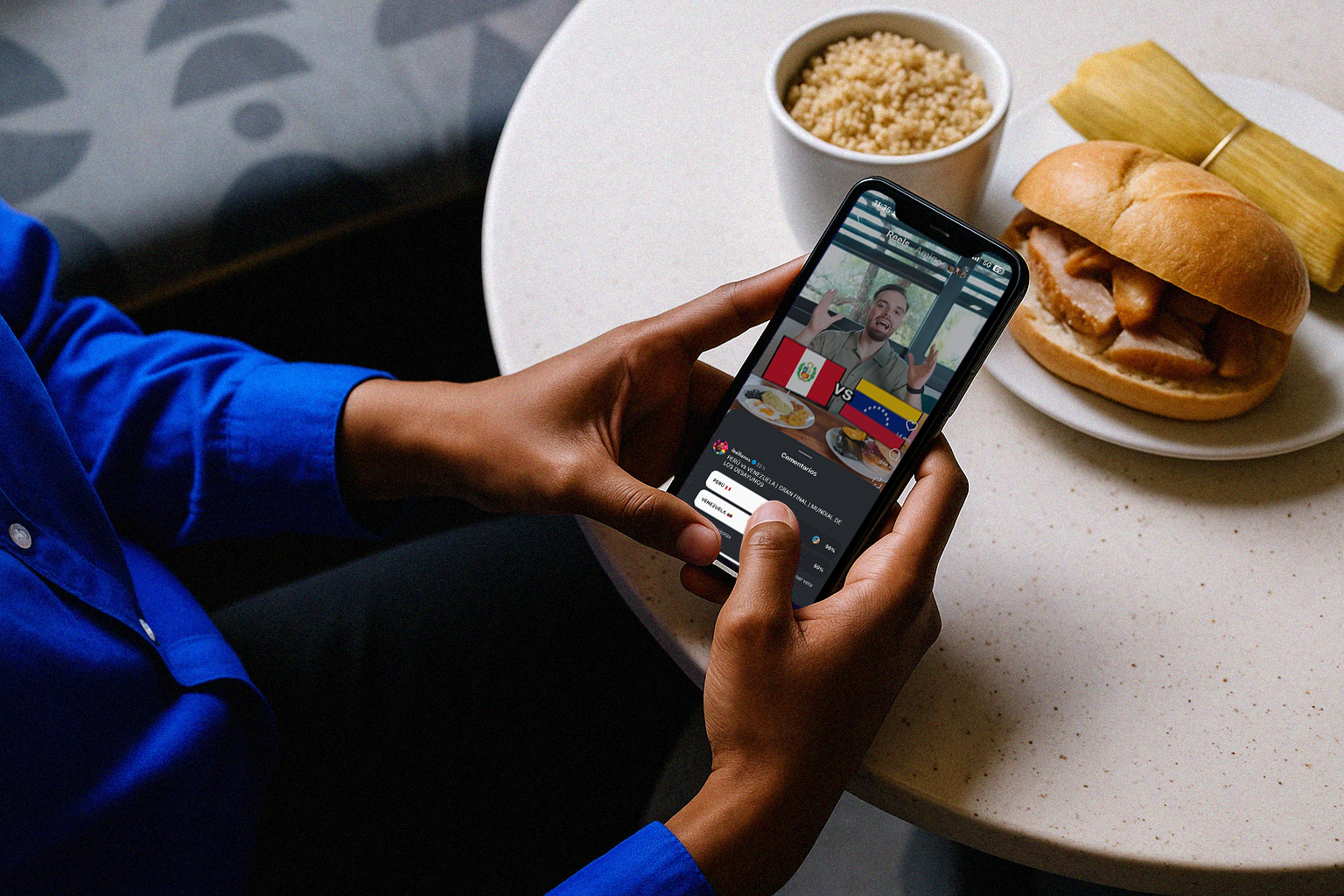
Peru is key! You see it in every post, every viral meme, and every achievement making noise around the world—from gastronomy to video games. What started as a TikTok joke has become a shout of national pride, and the visit of U.S. streamer IShowSpeed to Lima proved it: he not only hung out with local influencers, he was even named “mayor for two hours” and pulled off an acrobatic jump from the municipal balcony that went viral. From that moment on, media outlets and online communities echoed the phrase with force:
saying “Peru is key” is no longer just a meme—it’s the way to shout “Long live Perú!” to the world.
It’s not a trend, it’s love for chicharrón.
Have you voted for the pan con chicharrón yet? Hurry up, the final is almost here!
It’s the shout echoing everywhere: on social media, in the news, and even in the streets—no matter the brand or industry.
Peru ’s digital boom has been fueled by viral moments like the “Peru is key” meme, IShowSpeed’s visit, and above all, Ibai Llanos’ Breakfast World Cup. In this online tournament, Perú crushed it with over 8.1 million votes for its pan con chicharrón and tamal, beating Ecuador and going global. The hype was so big that politicians, media, and local brands jumped in, while Gamarra—the country’s biggest clothing hub—even launched custom T-shirts about the contest. This event didn’t just spark citizen excitement, it also cemented Peruvian gastronomy as a true nation-brand icon online, showing its massive pulling power and international reach.
Because Peru doesn’t just have the world’s best restaurant... it probably has the best too!
Once you’re on the bus, there’s no getting off.
Your child settles onto your lap, you light the fireplace, your eyes grow misty, and you begin to tell the story. If Peru once was key to the world, now it’s key to the entire digital universe. The gamer boom also carries a Peruvian face: in August 2025, the team Perú Unite made history by becoming champions of the Pokémon UNITE World Championships in California—making them the first Latin American team to ever lift the world trophy after defeating the Japanese favorites, Zeta Division, 3-1. “I mean, we beat the creators of the game.
The achievement of these five young Peruvians was celebrated as a source of national pride and recognized by international outlets like Infobae and Yahoo News, which highlighted how they “conquered the World Championship... securing the franchise’s most important trophy for the South American nation.
The phrase “Peru is key” went viral once again, as the tournament brought together more than 25,000 live attendees in Anaheim and reached nearly 1.1 million unique online viewers, with peaks of 185,000 simultaneous streams, cementing Peru’s presence before the eyes of the world.
The team itself thanked the support from home, reinforcing the idea that Peruvian talent transcends borders and that Spanish-speaking audiences deeply value their local champions. And beyond the sport, this victory ignited marketing as well: brands tied to gaming—hardware, telecommunications, energy drinks, and more—found in Peru a passionate and growing niche. Combined with other milestones like gaming tournaments, massive streams, and viral phenomena, this triumph positions Peru firmly on the global digital map, proving that its online culture is not just fleeting virality, but the consolidation of communities—gamers, foodies, streamer fans—driven by a uniquely Latin American passion.
The Peruvian Formula: Creativity, Community, and Digital Speed
What makes Peru’s digital ecosystem unique isn’t just virality, but the combination of three forces: creativity, community, and speed. Peruvian creativity shows up in memes, trends, and narratives that stand out in an ocean of global content. Community amplifies those ideas with overwhelming energy—from young people spontaneously launching digital campaigns to local brands cleverly joining the conversation. And then there’s speed: within hours, a meme born on TikTok can trend on X, Facebook, and even reach traditional media. This trio explains why phenomena like “Peru is key”, the Breakfast World Cup, or the Pokémon UNITE championship win are not isolated events but symptoms of a larger pattern: Perú has become a cultural accelerator for the region. For global brands, this means that any action in this market doesn’t just make waves locally—it has the potential to scale across all of Latin America.
“Dad, who was Peru Unite?”
Your child settles onto your lap, you light the fireplace, your eyes grow misty, and you begin to tell the story. If Peru once was key to the world, now it’s key to the entire digital universe. The gamer boom also carries a Peruvian face: in August 2025, the team Perú Unite made history by becoming champions of the Pokémon UNITE World Championships in California—making them the first Latin American team to ever lift the world trophy after defeating the Japanese favorites, Zeta Division, 3-1. “I mean, we beat the creators of the game.
The achievement of these five young Peruvians was celebrated as a source of national pride and recognized by international outlets like Infobae and Yahoo News, which highlighted how they “conquered the World Championship... securing the franchise’s most important trophy for the South American nation.
The phrase “Peru is key” went viral once again, as the tournament brought together more than 25,000 live attendees in Anaheim and reached nearly 1.1 million unique online viewers, with peaks of 185,000 simultaneous streams, cementing Peru’s presence before the eyes of the world.
The team itself thanked the support from home, reinforcing the idea that Peruvian talent transcends borders and that Spanish-speaking audiences deeply value their local champions. And beyond the sport, this victory ignited marketing as well: brands tied to gaming—hardware, telecommunications, energy drinks, and more—found in Peru a passionate and growing niche. Combined with other milestones like gaming tournaments, massive streams, and viral phenomena, this triumph positions Perú firmly on the global digital map, proving that its online culture is not just fleeting virality, but the consolidation of communities—gamers, foodies, streamer fans—driven by a uniquely Latin American passion.
Why is investing in Latin America key for global brands?
Latin America is no longer just an “emerging market.” Today, it’s a cultural and digital laboratory setting global trends. This entire movement has direct consequences for marketing: it shows that Latin America —and Peru in particular— has become a strategic and vibrant market for any global brand seeking relevance, where trends born from memes, gaming tournaments, or viral phenomena quickly spread and spark national pride.
The achievement of these five young Peruvians was celebrated as a source of national pride and recognized by international outlets like Infobae and Yahoo News, which highlighted how they “conquered the World Championship... securing the franchise’s most important trophy for the South American nation.
Joining these movements in real time (as KFC, Bembos, or BCP did with #PeruEsClave and the World Breakfast Cup) allows brands to connect emotionally with young, digital first consumers, who already surpass 70% internet penetration and 90% mobile access in the region.
Moreover, campaigns that reinforce local identities (such as pan con chicharrón or Peru Unite) enhance brand-country perception and open opportunities in booming sectors such as e-commerce, fintech, gaming, and entertainment. Sponsorship of events and collaborations with influencers or creators multiply organic reach in an ecosystem where culture —gastronomy, music, sports, memes— acts as an exportable form of soft power, and where authentic engagement can outperform million-dollar campaigns.
In conclusion, Latin America is now a global cultural laboratory, with Peru as its best example, showing that digital not only amplifies narratives but also strengthens passionate communities, turning the region into an unmissable destination for brand innovation and growth.
Positive leads the way in the new digital map.
At Positive, we understand that it’s not enough to simply “be on social media”—you need to understand the culture that drives it. Perú and Latin America are fertile ground for brands looking to grow, but they require strategy to avoid going unnoticed. That’s why we identify local insights that become global—such as gastronomic pride or gaming passion—and translate them into campaigns with regional impact and international resonance. Our approach blends creativity with data, combining qualitative analysis of trends, communities, and narratives with quantitative tracking of mentions, engagement, and hashtag growth to design strategies that are both measurable and effective.We know how to authentically place brands within viral phenomena, as many did by joining #PeruEsClave. We act as a bridge between the local and the global, helping brands from the U.S. or Europe connect with Latin American audiences through trust and real engagement. And we do it with close, memorable communication—crafting narratives that move people, spark laughter, invite participation, and turn consumers into fans. In short: Positive helps you ride the digital cultural wave of Latin America so your brand is not just a witness to what’s happening, but a protagonist in the conversations that matter.
.png)
UGC, CGC, IGC or What You See?
It All Started as Gossip and Turned into a Trend.
In Latin America, we always say gossip isn’t really our thing... but come on! We can’t help but smile when someone starts with the classic, “Did you hear?” or when a friend leans in quietly to say: “I’ve got chismecito.”
The same thing happens in the digital world. One day, you find yourself debating, laughing, and sharing memes about someone who appeared in a viral video... someone you probably barely know.
And that’s how this whole mess began: a video posted by content creator @_suplinna set off a snowball of comments about “doing UGC in Latin America.”
What is UGC?
UGC stands for User Generated Content: content created by regular, everyday users—not paid or pressured by brands—born from a genuine experience.
Think of it this way: when a customer uploads a photo or writes a comment without any payment involved, that’s authentic UGC.
According to Wikipedia, this type of content has allowed consumers to move from being passive participants to becoming active contributors on digital platforms.
And here’s a key stat: 79% of millennials and 70% of Gen Z make purchasing decisions basedon UGC.
Furthermore, “user-generated content influences the purchases of 79% of consumers, and 92% trust peer recommendations more than branded content.”
This proves that without a clear understanding of UGC, we risk losing the authentic touch that truly drives people to act.
What’s the State of UGC in Latam?
While in the U.S. and Europe many brands already include it as a key part of their business strategy, in Latin America the idea still lingers that a proper UGC execution is simply “I’ll send you one of my products so you can post something,” overlooking one of the most important promotional vehicles for generating awareness on digital channels.
Whether due to a lack of knowledge from the brands themselves or a lack of guidance from their agencies, the creative process for developing a UGC campaign often lacks clear KPIs, variety in entry hooks, proper editing by the agency, optimization of formats for media placement, or even the basic understanding that a UGC creator should know if their content will be boosted or not, and for how long.
As @mila_posada points out in this video:
In Latin America, only 37.7% trust sponsored posts, a figure that aligns closely with Europe andthe U.S., where the average is around 35%–39%, according to this data from Single Rain.
In contrast, well-executed UGC —the kind that feels like it came from an everyday person— has far greater power to connect than an influencer with all the production resources at their disposal.
On the other hand, according to a global report, the UGC marketing market is expected to grow from USD 6.7 billionin 2024 to USD 132.7 billion in 2034, with a CAGR of 34.8%.
This is a clear sign that our region is still not in sync with what’s coming.
The Confusion: Everything’s Called UGC
Here’s the big problem: many people call anything “UGC” if it’s a video with good editing, nice lighting, and camera flair, when in reality it’s paid branded content or disguised influencer work. It’s not that these productions are bad or less effective, but they lead to some serious misunderstandings:
- Brands don’t know if they’re paying for authenticity or for production.
- Creators don’t know how to position themselves: does authenticity have less value than a well-scripted, well-edited video?
- The audience grows distrustful: if everything looks paid, who’s really saying, “this is dope”?
This video of @yuyo.says can actually help us understand the communication differences between one and the other.
Clear Differences to Avoid Confusion
These acronyms are everywhere, but it’s important to keep them straight:
- UGC (User Generated Content): spontaneous, authentic content created by regular users.
- IGC (Influencer Generated Content): content from people with an audience, who usually charge for it —this production is no longer anonymous.
- CGC (Creator Generated Content or Company Generated Content): content created either by the brand or by hired creators, with an editorial focus and controlled quality.
According to Territory Influence: "UGC thrives on authenticity and community, while IGCl everages the influence and creativity of people with an established online presence."
So, how should these differences be addressed in a campaign led by a marketing agency? This video by @theinexpert explains it:
Where Should We Go Next?
These acronyms are everywhere, but it’s important to keep them straight:
- Market Education: Brands and agencies must know how to distinguish between UGC, IGC, and CGC, and use each one in its proper role.
- Creator Professionalization: Creators should know how to quote, deliver, and sell their proposals without disguising themselves as UGC when they are actually IGC or CGC.
- Building an Authentic Culture: Users should feel good about sharing, without thinking that everything is a hidden transaction.
At Positive, we not only understand the differences between UGC, IGC, and CGC, but we also apply them in a structured way within every campaign. This allows us to design strategies where each type of content fulfills its exact function, boosting authenticity and maximizing results. This way, we help international brands land organically in the Latin market, connecting with audiences through the language, codes, and culture that truly move them.

iPad, Paper and Scissors. Mix Media Emerges as a Creative Alternative
It’s becoming increasingly hard to surprise anyone with what we see on social media. Fortunately, there are still techniques that break the mold — like collage.
Whether static, animated, or mixed with physical objects, collage and mix media are experiencing a revival on social platforms driven by Gen Z.
We’re talking about a visual storytelling style that blends illustration, archival material, real-life objects, and animation — transforming into small films known as video collages, analog interventions in a digitized world, or a combination of various elements that grab attention and stand out in a saturated feed.
Let’s take a closer look at the impact of a technique that once seemed reserved for editorials or contemporary art — and is now ready to be used in brand content.
Is Mix Media a Response to AI?
We’re seeing more and more campaigns that feel like they came from the same prompt — which might be a normal curve in the creative industry’s process of adapting to AI. (Remember when there was a time all brands were basically posting the same things on social media?).
In the midst of that debate, collage emerges as an alternative. With its imperfect nature, it brings back the human touch, artisanal detail, and the beauty of chaos.
Each piece is unique, non-replicable. And in these times of digital saturation, that feels like a breath of fresh air.
Latin America is no exception to the growing interest in alternative techniques. More and more creators are taking cutting, pasting and digitizing very seriously — not just as a hobby, but as a new visual language.
Here are some of the names worth following:
Latam Creators Who Are Seriously Killing It
- Cortaypega: Colombian artist who creates editorial collages and collaborates with brands. Her style is poetic, rich in symbols and soft narratives.
- Vero Calderon (@elvlogdetrin): Peruvian writer and artist. She has collaborated with Buscalibros, showing that more intimate content can also be part of a campaignKamiru: This Peruvian artist has a music video-style aesthetic that grabs attention. She created a video collage for Reebok with a very compelling editing rhythm.
- amiru: This Peruvian artist has a music video-style aesthetic that grabs attention. She created a video collage for Reebok with a very compelling editing rhythm.
- Valcollage: Venezuelan artist who teaches how to create collages, shares resources, and has over 40,000 followers on her platforms.
- Mara Ocejo: Mexican collagist who has illustrated for major outlets like The New York Times — a clear example of how this technique can reach global media.
- Magu Villar: Argentine collagist who blends illustration, collage, and storytelling for social media.
Would This Technique “Stick” with My Brand?
Can you imagine a campaign where the product doesn’t float on a white background, but instead becomes part of a handcrafted scene — built with paper, threads, and cutouts that move in and out of frame? Or a reel where, instead of generic motion graphics, there’s a small, handmade story?
This type of content can:
- Be the hero content of a product launch.
- Work as content hooks for social media.
- Stand out during seasonal campaigns (Christmas, Father’s Day, etc.).
Connect with audiences tired of “more of the same.”
One thing we love about this technique is that it forces a previous step that makes all the difference: the analog one. And that’s key. Before anything is rendered, creators play with paper, fabric, magazines, modeling clay, and scissors. That physical process gives the piece a kind of soul that digital simply can’t replicate.
So, How Do We Build This Together?
At Positive, we can help you:
- Find and connect with these types of creators.
- Develop editorial, product, or campaign ideas using mix media.
- Integrate collage into your content strategy.
- Explore other techniques that can enhance your brand’s visual identity.
According to this LinkedIn article, in the coming years there will be a growing trend to value human-made content over artificial output.
This isn’t about cutting and pasting for the sake of it. It’s about telling stories differently. Because in a world where everything starts to look the same, daring to stick things together in a new way might be exactly what your brand needs.
.jpeg)
Growth hacking in Spanish and technical jargon
Let’s start in Miami. A startup founder—let’s call him Chad—is pitching his edtech app to a room full of Colombian parents. His deck is filled with words like “CAC,” “LTV optimization,” “scaling loops,” and “viral coefficient.” He ends his speech with: “And that’s how we hacked our way to 100K users!”
The room stares back at him like he just recited the periodic table in Klingon. One of the parents timidly raises a hand and asks: “¿Pero qué significa hackear usuarios?”
Spoiler: the pitch tanked.
Spoiler #2: this happens more than you think.
Jargon doesn’t travel well. Especially when you’re crossing cultural borders, not just linguistic ones.
“We’re not translating. We’re transplanting.”
That’s a phrase we use often in Latin American marketing strategy. Because when a U.S. brand thinks all it takes to scale in Spanish-speaking markets is to hire a translator or copy-paste their tactics into a Canva template with salsa music… things go wrong. Fast.
Growth hacking isn’t just about A/B tests and onboarding funnels. It’s about contextual velocity.
And if the context isn’t right—your growth will rot before it ripens.
Let’s break this down with an example you’ll love (or hate, depending on where your budget went):
A DTC brand selling smart fitness gear tried running Facebook ads in Mexico with copy like:
“Reach your KPIs. Bio-optimize your day. Hack your routine.”
And here’s what the audience read:
“Suena bonito, pero ¿qué mier... están diciendo?”
Engagement was dead. Comments were mostly emoji laughs and confused reactions. The campaign tanked.
Why? Because nobody in Guadalajara, Bogotá or Lima is thinking about 'bio-optimization' when doing sit-ups. They’re thinking about not getting yelled at by their trainer or about how they’ll explain to mamá that they bought another gadget instead of paying off their credit card.
Growth needs cultural nuance. Not cultural negligence.
Let’s make one thing clear: the Latino market doesn’t need you to “dumb down” your brand.
They just need you to understand what they value.
If your growth strategy assumes that everyone thinks like a Bay Area product manager… you’ll miss the point (and the profit).
Here’s what actually drives conversion in Latin America:
- Trust, not just tech.
- Social proof from people like me, not influencers from Silicon Valley.
- Relatability over automation.
- Emotion-first, data-second. (Yes, we love dashboards—but we cry at commercials too.)
You can be the most technical, optimized, AI-powered startup in the world, but if you say “retargeting funnel” to someone whose idea of marketing is still tied to la feria del barrio, you’re not landing. You’re floating.
From Growth Hack to Culture Crack
So, what’s the fix? Should we erase every metric-driven tactic from the playbook?
No. But we do need to reframe.
Growth hacking in Spanish isn't just translation. It's reinvention.
It’s asking:
- Would this campaign go viral in Cartagena without paid media?
- Would a Cuban abuela understand the value prop?
- Would a Mexican Gen Z repost this if it didn’t have a celebrity?
You start winning when your brand stops acting like a tourist and starts acting like a local disruptor.
The Latin American Growth Formula (aka: what your agency should actually be doing)
Want growth? Start here:
1. Local slang isn’t optional.
If your CTA says “optimize your flow,” you're out. If it says “pon tu rutina en modo bestia,” you're in. (Yes, even for SaaS.)
2. Humor beats data—until trust is built.
Remember: many Latin American consumers have been burned by shiny foreign tech. They won’t be impressed by charts until they like you.
3. Your metrics need a human face.
We don’t just want to hear “+78% user retention.” We want to meet Lucía, a 37-year-old mom in Quito who’s using your app to help her kids study. Tell us about her.
4. Let the emotion lead the funnel.
Start with storytelling. Then plug in the tracking pixels. Not the other way around.
So… should you go it alone?
You could.
You could keep running Google Ads in Spanish that sound like Google Translate and crossing your fingers for CAC to drop.
Or…
You could partner with an agency that’s been in the trenches—testing, launching, and scaling brands that actually stick in Latin America.
Because when you treat the Latino market like a “segment,” you lose. When you treat it like a culture, you win.
And here’s the thing: we don’t just get the language. We get the rhythm. The timing. The emotion. That’s what drives sustainable growth south of the border. So next time you're thinking of hacking growth in Spanish, maybe start by unlearning English.