.png)

.jpeg)
Prime Time is Latin: What Bad Bunny’s Presence at the 2026 Super Bowl Reveals About the Cultural Power of This Side of the World

A perspective from Positive Agency on the new protagonism of Latin culture in global marketing.
The year is coming to an end. Christmas lights are already glowing in shopping malls, and among them, that synthetic 80s music—born from MIDI rhythm boxes—blends with what’s coming through my headphones.
As I warm up my coffee and open my laptop to join the first meeting of the day, I think about how everything changes. At the agency, we understand that movement as something natural. Our work is not just to communicate but to read and decode the digital culture of a region as dynamic as Latin America.
In the virtual waiting room, someone has left their microphone on. A Caribbean track seeps in—a mix of percussion and Spanglish that takes me back to the first days of the year, close to my birthday. I don’t have photos on my desk, but one thought pops into my head: “I should’ve taken more pictures.”
Curious title for an album, I think, right as I’m about to join a meeting where images mean everything—and where we’d never think of “throwing them away.”
Musical tastes aside, that coincidence makes me pause. Between metrics, strategies, and deadlines, we sometimes forget why culture matters so much in what we do. Maybe hearing Bad Bunny in the waiting room, while scrolling through Resident Advisor, helped me connect the dots.
A Cultural Game-Changer for Global Marketing
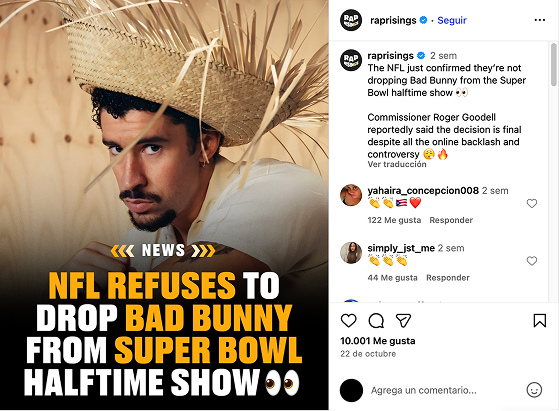
When the NFL confirmed Bad Bunny as the headliner for the 2026 Super Bowl Halftime Show, it didn’t just announce a performance—it sent a message to the marketing world.
The Puerto Rican artist, who sings mostly in Spanish or Spanglish, represents a generation that embraces its roots and celebrates cultural identity.
While millions prepare to watch the biggest game of the year, brands are preparing to understand how Latin culture has become the emotional engine of the U.S. market.
The Latin Shift of the U.S. Market
Over the past decades, the growth of the Latin audience in the United States has reshaped the country’s consumption map.
Latinos now represent over 20% of the total population (U.S. Census Bureau, 2024) and show one of the fastest-growing rates in purchasing power
Yet, according to a 2025 study by XR Global source , only 4% of Super Bowl commercials featured Latin talent or cultural references—a figure far below America’s demographic reality. That gap signals a clear opportunity for Latin marketers.
The distance between cultural influence and commercial visibility remains wide—but it’s closing fast.
Bad Bunny embodies that transformation. He’s no longer a “Latin artist succeeding in the U.S. but a global artist redefining
the mainstream, reflecting decades of Latin American culture exported to the world.
For brands, this means an open door to step into the landscape of Latin cultural storytelling—a space that deeply interests us.
In 2025, the advertisers who dominated the Super Bowl conversation—Anheuser Busch, Michelob ULTRA, Lay’s, and Pfizer— did so not only through visual creativity but through narrative authenticity.
Audiences no longer respond to spectacle without purpose; they seek coherence, tone, and cultural rhythm.
In 2026, Spanglish will be the event’s native language.
“Spanglish, Latin aesthetics, and cultural references will no longer be creative winks—they’ll be the first lights of a new era in global communication.”
The challenge isn’t to speak like Latinos, but to speak from a culture that has become collective—and no longer foreign—to the American market.
The Power of Creating from Culture
Advertising has learned that translation isn’t enough.
The next step is to co-create from within culture, not just represent it superficially.
This means integrating Latin talent across every level of the creative chain—from copywriters and art directors to strategists and data analysts—to generate genuine and original campaigns.
That’s the approach we take at Positive Agency.
As a team, we believe cultural identity not only inspires creativity—it defines strategy.
We combine local insight, regional sensitivity, and global execution to help brands connect with audiences through emotion and cultural truth.
Bad Bunny is proof that we’re on the right path. Latin culture is no longer overlooked—it’s the starting point of a new, hyperconnected, transcultural form of communication.
Brands that understand this will stop “including” and start belonging to cultural movements.
According to Think with Google, bilingual consumers process emotions more intensely in their native language.
For the 2026 Super Bowl, using Spanish or Spanglish won’t be a differentiation tactic—it will be a manifestation of cultural authenticity.
In this context, language stops being a code and becomes a form of connection.
Latin Culture Is Inevitable
The challenge for brands isn’t to “ride” the Latin wave, but to understand that this wave already sets the rhythm of global culture. Brands that grasp this will be closer to what’s now known as cultural leadership.
“In 2026, it won’t be enough to be at the Super Bowl. Brands will need to be in the conversation across their digital ecosystems.”
Brands That Already Understand the Latin Power
Before Bad Bunny takes the world’s biggest stage, some brands have already opened the path for Latin culture in U.S. advertising.
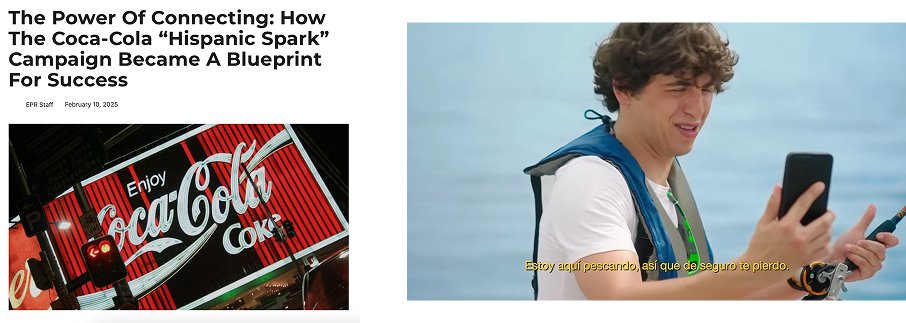
Coca-Cola, with its Hispanic Spark campaign, proved that a Latin narrative can coexist with a global brand—authentically and at scale.
T-Mobile has launched bilingual campaigns like #SomosMás spot, designed for Hispanic U.S. markets, celebrating the diversity and resilience of the Latin community. It also maintains T-Mobile en Español and promotions for families living between two cultures.
That narrative consistency has allowed it to build a genuine bond with Latin audiences.
According to Kantar (2024), 64% of Hispanic consumers prefer brands that recognize their cultural identity—an insight T-Mobile has successfully turned into growth. (Source: Kantar North America, Creating Marketing Impact with the Hispanic Community)
These examples confirm the trend: Latin brands are no longer asking for space in the U.S. market—they’re building it themselves.
That sets the stage for Bad Bunny’s performance to be the rule, not the exception.
The Power of Creating from Culture
That same cup of coffee from the morning still sits on my desk, now a little cold—the moment I enjoy it most, because it means the day is almost over.
With the last sip, I think about how the 2025 Super Bowl proved that the world’s most expensive advertising slot isn’t won by budget, but by cultural purpose.
In 2026, that purpose will speak two languages and resonate across millions of homes that see Latin culture as a shared identity.
At Positive Agency, we believe that taking a strategic and creative stance toward this phenomenon brings us closer to the right path.
That’s our competitive advantage.

.jpg)