LATAM made a big statement with the Club World Cup
Bueeee, folks! So, how was the First Club World Cup? Well, it was just as good as it gets — especially for content creation in Latin America.
How is it possible that a tournament no one paid attention to at first became one of the most-watched events in the world and a key platform for content creation in the region?
To find out, we’ll dive into the memes, the broadcasts, the videos, and everything this high-impact global conversation left behind — and uncover those insights that show how sports and digital business go hand in hand.
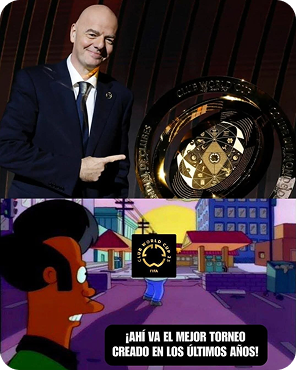
Cheers to DAZN’s digital strategy.
To begin understanding the impact this Club World Cup had in the digital ecosystem, we need to look at DAZN — the broadcaster that bet on an innovative digital strategy that revolutionized how the tournament was consumed in Latin America.
The platform streamed all the matches live for free, breaking away from the traditional pay-per-view model. This bold move not only made it easier for millions of fans to follow the competition, but also removed access barriers.
It was precisely this coverage that sparked what could be considered the first big conversation topic of the tournament.
A storyline that quickly turned into a source of memes, videos, and real-time engagement. Let’s take note of how a conversation can be capitalized on social media.

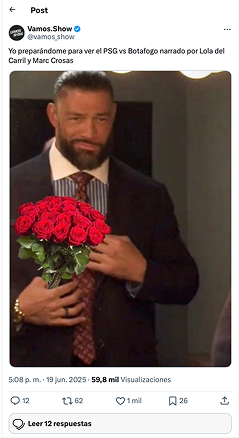
Lola del Carril and Marc Crosas: what a duo, mamita querida.
In the middle of the Porto vs Fluminense match, Lola and Marc began exchanging opinions about the game — some of which seemed a bit out of context. The mutual compliments they gave each other live on air were the spark that ignited a fun online conversation, with many claiming there was flirting going on between the Argentine commentator and the Spanish-Mexican ex-footballer.
The wave of memes, tweets, videos, and reactions became an unbeatable opportunity for DAZN, and for the commentators themselves, who rode the wave of popularity to present a more relatable and social media-friendly image during the broadcasts.
Translation:
A total banger in terms of viewership for DAZN and viral content — a brilliant real-time play by Lola and Marc, and a classy response to those who believe football should only be consumed through serious analysis and tactical breakdowns.
If there’s one thing we Latinos are great at, it’s finding the funny side of everything — and knowing how to run with it, especially on social media.
"Mom, when I grow up I want to be like the content creators in LATAM"
In addition to the official commentators, influencers and content creators from Latin America played a leading role in amplifying the Club World Cup experience in the digital ecosystem.
If there’s one thing we Latinos are great at, it’s finding the funny side of everything — and knowing how to run with it, especially on social media.
For example, Argentine streamer Davoo Xeneize, known for his passion for Boca Juniors (xeneize), hosted watch parties, live reactions, and match analysis across his channels on Kick, YouTube, and other platforms. With over 2 million subscribers on YouTube, Davoo drew tens of thousands of fans to watch the matches live with him.
Goals, celebrations, commentators, or memes — there were also specialized creators who viewed the sport from a different angle, one more aligned with business.
A clear example of this is the YouTube channel “El Negocio del Fútbol,” which focused on analyzing the economic impact of the next edition of the Club World Cup.
Other creators like “La Cobra , ” Charlie Carrillo , and Danigoals became amplifiers of everything happening throughout the tournament — from match results and player ratings to predictions for each new round. It was absolute proof of the drawing power that football has in Latin America, and of the wide variety of content formats it inspires, ranging from humor and economic analysis to even lifestyle content.
Did you see what the brands and creators did?
Many sports brands took advantage of their reach — for example, Adidas Argentina and Amstel sponsored content with Lola del Carril due to her rising popularity, while other sponsors invited streamers to create content during the tournament.
This collaboration between brands and creators boosted content distribution on social media, turning news and moments from the Club World Cup into viral topics that spread across every corner of the internet in Latin America.
In the end, the tournament’s digital conversation was no longer dominated only by FIFA’s official accounts or traditional media — it was co-created by a large community of digital storytellers who brought the passion of football to Twitter, TikTok, Instagram, YouTube, and Kick simultaneously.
Dive into the digital sports market in LATAM
This whole picture shows us that Latin America is one of the biggest, most passionate, and most committed football markets in the world. The case of DAZN made it clear:
When relevant and accessible content is offered, the Latin audience responds massively—creating memes, showing appreciation, and driving virality. With a shared language and rapid growth across platforms, what starts in one country can go viral across the region.
Over 9.2 million people watched the Spanish-language broadcast in the U.S. alone. 2.49 million attended matches in stadiums across the U.S.; Brazil, Argentina, and Mexico led foreign ticket purchases. And many global trends start right here. Investing in LATAM means gaining reach, loyalty, and a culture that turns content into community.
The digital footprint of the 2025 Club World Cup in LATAM shows how this region turns fleeting moments into long-lasting narratives, well beyond the final whistle. Embracing this mindset allows brands to connect more authentically with the Latin American audience — and to make sure their message resonates long after the event ends.
.jpg)
Dictionary of Latin gestures your brand needs to understand
You don’t need a PhD in anthropology to screw up in Latin America—just post the wrong emoji. Or launch a video ad where a character waves their hand a bit too freely. Boom: brand cancelled, comments on fire, and a crisis call with your agency on a Sunday.
Welcome to the world of gestures. A subtle, powerful, and often-overlooked layer of communication that can either boost your cultural relevance or make your brand go viral for all the wrong reasons. And no, not the good kind of viral.
Let’s be clear: Latin America is not one country. It’s twenty. And each has its own codes.
But there are patterns—gesture behaviors, meanings, and taboos that your marketing team should master. If your brand wants to survive in the Latin market (and maybe even be loved), here’s the unsugarcoated guide to the semiotics of the hands, eyes, and facial micro-movements that can kill—or convert—your campaigns.
The Raised Eyebrow: Yes, we’re judging you 🤨
In countries like Peru, Chile, or Venezuela, a raised eyebrow can mean “I’m listening”, “You serious?”, or “Try again”. Use this in a character's animation or in a gif and you might land your brand in a sarcastic tone you didn’t mean. Especially in customer service interactions, emojis that emulate this (think 🤨) can read as passive-aggressive.
“Not all expressions translate—some accuse.”
The “Finger Purse”: Italian? Yes. But also Caribbean. 🤌
The pinched-fingers-together gesture 🤌 (tips all touching and facing upward), often associated with Italians saying “What do you want from me?”, is common in Dominican Republic and Puerto Rico—but it doesn’t mean the same thing. In DR, it can mean “Let me explain” or “Hold up.” It’s assertive. Use it wrong, and it becomes condescending. Use it right, and it can express passion or urgency.
The Chin Flick: Silence, or worse 🤷♂️
In Brazil or Argentina, flicking the back of your fingers from under the chin (sometimes confused with a shrug 🤷♂️) is not a charming “meh.” It means “I don’t care”, and sometimes “F** you.”* Including a character doing this—even subtly—in a meme or video can completely change your message.
“Gestures are louder than captions.”
The Hand Clap: Applause? Maybe. A Threat? Definitely. 👏
If you’re in Colombia or El Salvador and someone claps their hands at you once, hard and loud 👏, it’s not praise. It’s a challenge. A way to say “You better listen” or “You’re testing me.” Brands that show people clapping in scenes of celebration should keep it warm, soft, and multiple claps—not a single, sudden hit. Otherwise, the street tone leaks in.
The Thumb Between Fingers: That’s not cute. That’s old-school vulgar. 🤏
In places like Mexico or Peru, putting your thumb between your index and middle fingers (not a standard emoji yet, but imagine 🤏 with the thumb inside) has historically meant “I’m insulting you” or “Here’s your disrespect.” Some brands use this as a quirky logo element or sticker. Don’t. It's not ironic. It's just dated and offensive.
The “Come Here” Finger Wiggle: In the U.S.? Innocent. In Latin America? Borderline creepy. ☝️👉
Using the upward, single finger curl ☝️ or beckoning motion 👉 to signal someone over is extremely common in the U.S. But in many Latin countries—especially conservative areas like Guatemala or Paraguay—it feels intimate, even inappropriate. Think twice before your mascot does it. You’re not summoning a toddler—you’re triggering discomfort.
The “Peace” Sign: Not always so peaceful ✌️
In Chile, Colombia or Uruguay, turning the palm inward while flashing the “peace” sign ✌️ can be read as mocking or offensive. It’s about angle, intention and local context. If your brand relies on visual metaphors like this in reels or story ads, angle it right or don’t use it at all. “A rotated hand can rotate your brand perception.”
Hands Together Like Praying: Not always gratitude 🙏
Many brands (especially beauty or wellness) use the praying hands gesture 🙏 to express thankfulness. But in some regions of Mexico and Bolivia, this is tied to death rituals or mourning. It’s not offensive per se, but it may communicate something you didn’t mean. That “thank you for your support” post might accidentally read like a memorial.
So, why should your brand care?
Because Latin audiences don’t just see your content—they feel it. They grew up with mothers reading body language better than FBI profilers. They know what every eyebrow, hand twist, and head tilt means. So when a brand gets it wrong, it’s not forgiven as an innocent cultural slip. It’s judged as lazy.
And the worst part? You won’t always hear the backlash. It won’t be an email. It’ll be disengagement, mistrust, or mockery in private WhatsApp groups.
What can you do?
Work with local experts who get the nuances.
At Positive Agency, we’ve seen it all—brands trying to “connect” using globally approved emoji packs, generic memes, or hand signs that go viral only because they were awkward. Our creative campaigns go through culture filters, local translators, and emotional sniff tests before hitting “publish.”
We don’t guess. We know—because we grew up in it.
If you want content that doesn’t just survive in LATAM but thrives, talk to an agency that speaks the language—body and all.

iPad, Paper and Scissors. Mix Media Emerges as a Creative Alternative
It’s becoming increasingly hard to surprise anyone with what we see on social media. Fortunately, there are still techniques that break the mold — like collage.
Whether static, animated, or mixed with physical objects, collage and mix media are experiencing a revival on social platforms driven by Gen Z.
We’re talking about a visual storytelling style that blends illustration, archival material, real-life objects, and animation — transforming into small films known as video collages, analog interventions in a digitized world, or a combination of various elements that grab attention and stand out in a saturated feed.
Let’s take a closer look at the impact of a technique that once seemed reserved for editorials or contemporary art — and is now ready to be used in brand content.
Is Mix Media a Response to AI?
We’re seeing more and more campaigns that feel like they came from the same prompt — which might be a normal curve in the creative industry’s process of adapting to AI. (Remember when there was a time all brands were basically posting the same things on social media?).
In the midst of that debate, collage emerges as an alternative. With its imperfect nature, it brings back the human touch, artisanal detail, and the beauty of chaos.
Each piece is unique, non-replicable. And in these times of digital saturation, that feels like a breath of fresh air.
Latin America is no exception to the growing interest in alternative techniques. More and more creators are taking cutting, pasting and digitizing very seriously — not just as a hobby, but as a new visual language.
Here are some of the names worth following:
Latam Creators Who Are Seriously Killing It
- Cortaypega: Colombian artist who creates editorial collages and collaborates with brands. Her style is poetic, rich in symbols and soft narratives.
- Vero Calderon (@elvlogdetrin): Peruvian writer and artist. She has collaborated with Buscalibros, showing that more intimate content can also be part of a campaignKamiru: This Peruvian artist has a music video-style aesthetic that grabs attention. She created a video collage for Reebok with a very compelling editing rhythm.
- amiru: This Peruvian artist has a music video-style aesthetic that grabs attention. She created a video collage for Reebok with a very compelling editing rhythm.
- Valcollage: Venezuelan artist who teaches how to create collages, shares resources, and has over 40,000 followers on her platforms.
- Mara Ocejo: Mexican collagist who has illustrated for major outlets like The New York Times — a clear example of how this technique can reach global media.
- Magu Villar: Argentine collagist who blends illustration, collage, and storytelling for social media.
Would This Technique “Stick” with My Brand?
Can you imagine a campaign where the product doesn’t float on a white background, but instead becomes part of a handcrafted scene — built with paper, threads, and cutouts that move in and out of frame? Or a reel where, instead of generic motion graphics, there’s a small, handmade story?
This type of content can:
- Be the hero content of a product launch.
- Work as content hooks for social media.
- Stand out during seasonal campaigns (Christmas, Father’s Day, etc.).
Connect with audiences tired of “more of the same.”
One thing we love about this technique is that it forces a previous step that makes all the difference: the analog one. And that’s key. Before anything is rendered, creators play with paper, fabric, magazines, modeling clay, and scissors. That physical process gives the piece a kind of soul that digital simply can’t replicate.
So, How Do We Build This Together?
At Positive, we can help you:
- Find and connect with these types of creators.
- Develop editorial, product, or campaign ideas using mix media.
- Integrate collage into your content strategy.
- Explore other techniques that can enhance your brand’s visual identity.
According to this LinkedIn article, in the coming years there will be a growing trend to value human-made content over artificial output.
This isn’t about cutting and pasting for the sake of it. It’s about telling stories differently. Because in a world where everything starts to look the same, daring to stick things together in a new way might be exactly what your brand needs.
.jpg)
TikTok leads in LatAm — and you can take advantage of it
Remember when marketing in LATAM was about billboards, TV, and radio spots, and we had to pretend digital was just a fad? Good times, right? Fast forward a few years, and now marketers can’t escape the scrolling vortex of TikTok. If you’re reading this, chances are you're no longer debating whether TikTok is "worthy" of your marketing dollars—you’re simply trying to figure out why it's crushing the social media competition in Latin America and how your brand can capitalize on it.
TikTok's Rise: More Than Just Dancing Teens
Sure, it started with teens dancing awkwardly to viral hits, but anyone still clinging to that stereotype has missed the bigger picture. TikTok's explosive growth in LATAM—Brazil, Mexico, Argentina, Colombia, and Peru leading the charge—is a testament to the platform’s intuitive understanding of local culture and trends. Unlike other platforms that tried to replicate global strategies locally, TikTok flipped the script, deeply integrating itself into LATAM culture. This approach turned the platform from "nice-to-have" to a strategic essential.
TikTok’s monthly active users in LATAM surpassed 150 million in 2024 alone. That's roughly the population of Mexico. Let that sink in.
Why is TikTok Dominating LATAM?
It's not sorcery (well, maybe just a bit)—it's actually down to a few key strategic moves:
First, TikTok didn’t just translate its content—it transformed it. Its localization strategy was clear: embracing the idiosyncrasies, humor, slang, and social cues specific to each LATAM country. Second, its algorithm. Ah, the famous algorithm. It's so precise it borders on creepy. Users find themselves in hyper-specific niches faster than you can say "engagement metrics."
Moreover, TikTok successfully captured the nuances of storytelling unique to LATAM—where emotions, humor, and authenticity reign supreme. In short, TikTok didn't force LATAM to adapt; TikTok adapted to LATAM.
Leveraging TikTok’s LATAM Dominance for Your Brand
Now, for the important part—how can your brand actually leverage TikTok’s LATAM dominance effectively?
Forget generic ads. Seriously. LATAM users sniff out inauthenticity faster than your clients question their ROI. Brands that win here embrace genuine storytelling, culturally relevant narratives, and yes—a dose of sarcasm and wit.
Here are a couple of strategic pillars your brand needs to build on:
1. Authenticity Over Everything
You know that polished corporate voice you love so much? Leave it behind. LATAM audiences on TikTok connect with real, raw, and relatable content. Brands excelling here leverage user-generated content (UGC), collaborate with local creators, and aren't afraid to show their human side.
If you’re still doing corporate-speak, your brand might as well wear a neon sign that says, "I don't belong here."
2. Tap Into LATAM’s Cultural Pulse
LATAM is not a monolith. Your campaign in Argentina won’t automatically work in Colombia. Dive into hyper-local trends, memes, and influencers. Partnering with specialized agencies deeply rooted in LATAM culture (hello, specialized social media and creative campaign agencies) can be a game changer. They already speak the language—figuratively and literally—and know how to turn engagement into meaningful ROI.
The Uniqueness of LATAM: Why Specialized Agencies Matter
Understanding LATAM's digital audience isn't as straightforward as applying a global template. The region’s idiosyncrasy is a competitive advantage if leveraged properly.
Agencies specialized in social media, digital analytics, creative campaigns, and paid media, especially those embedded in the LATAM market, can bridge the gap between global ambitions and local execution. They offer insights that generic global firms simply cannot match, making them essential partners in your TikTok LATAM strategy.
TikTok Isn't Just a Platform—It's a Cultural Playground
If you're not yet on TikTok in LATAM, your brand is missing the party, literally and figuratively. LATAM isn't just adopting TikTok; it's reshaping its landscape. As a marketer, the question is no longer if your brand should be on TikTok but how well you can integrate into the unique tapestry of LATAM digital culture.
In short, if your brand hasn't embraced TikTok in LATAM yet, it's about time to step up—or watch your competitors dance away with your audience.
.png)